grace grits and gardening

ramblings from an arkansas farm girl

  • Home
  • Bio
  • Publishing
  • SHOP!
  • Garden
  • Food
  • Reading & Books
  • Sunday Letter

what the dogs smell (let it rain)

March 11, 2015 By Talya Tate Boerner

My walks with Lucy and Annabelle consist more of stopping and starting than walking. We play a sniffing game, especially after a rain or snowstorm. For just one day, I’d love to be able to smell what the dogs smell. To be that alert and aware, so alert they nearly pull my arm out of socket when a scent hits their noses and yanks me in a completely different direction.

What’s in the rain?
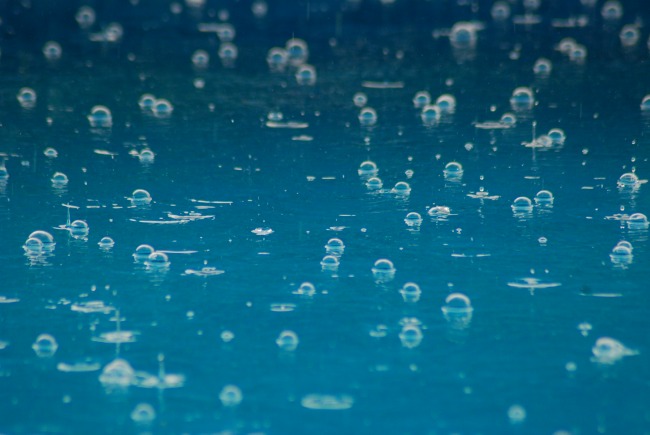
what the dogs smell

Does the water revitalize the scent of the soil, the tracks of the squirrel, the mark of another dog? Or is there more to it?

The same rain has fallen since the beginning of time.

Rain.

Evaporation.

Rain.

Evaporation.

And with the process, a world of smells travels from the ground, into the rivers and lakes and oceans and into the clouds overhead. The smells of yesterday. History. Animals, extinct and present. People, here and long gone. Every smell that ever existed has been soaked into those rain droplets and snowflakes.

That’s what I like to imagine anyway.

The history in the smell of rain is responsible for our less than smooth strolls. It’s not just dog pee.
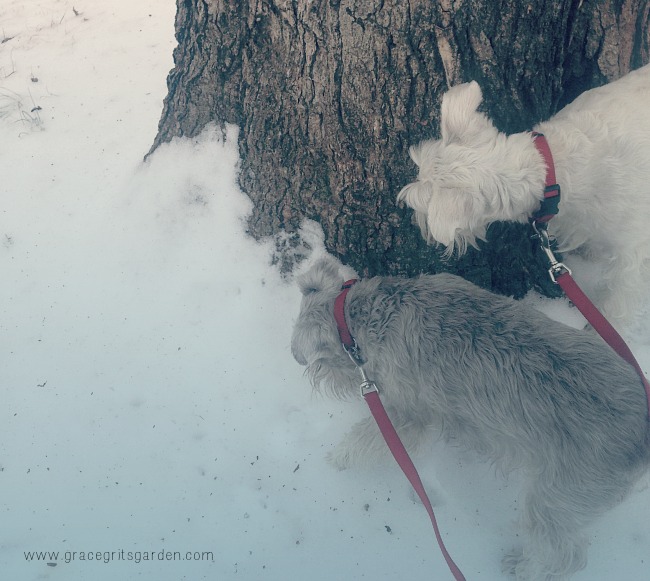
what the dogs smell

I love the smell of rain—that distinct earthy aroma that’s difficult to describe yet immediately noticed. A smell that always grabs my attention and makes me pause and inhale long and deep. What do the dogs smell? The explosion of a Civil War musket? Tracks left behind by the Cherokee who settled in this area? The smell of a wolf pack, their ancestors?

Or is it merely the squirrel sitting on the branch above their heads?

Grace Grits and Gardening

Farm. Food. Garden. Life.

[tweetthis]I’d like to smell what the dogs smell. #historyintherain[/tweetthis]

Musical Pairing:

Eric Clapton, Let It Rain

“Smell is a potent wizard that transports you across thousands of miles and all the years you have lived. The odors of fruits waft me to my southern home, to my childhood frolics in the peach orchard. Other odors, instantaneous and fleeting, cause my heart to dilate joyously or contract with remembered grief. Even as I think of smells, my nose is full of scents that start awake sweet memories of summers gone and ripening fields far away.”

― Helen Keller

 

on researching and writing and keeping it real

March 2, 2015 By Talya Tate Boerner

When I decided hey, I’m gonna write a book, I had no idea the amount of research that would be involved. Researching. Writing. Sitting around eating Jiffy Pop helps me keep it real. It’s all part of the deal I made when I set out on this adventure. One leads to another, Sunday melts into Monday, and shockingly it’s March. A year later. And I’m still working on “my book”. What began as memoir has morphed into fiction and taken me on a path I never imagined, even though I’m the person doing the imagining. Crazy how that works.

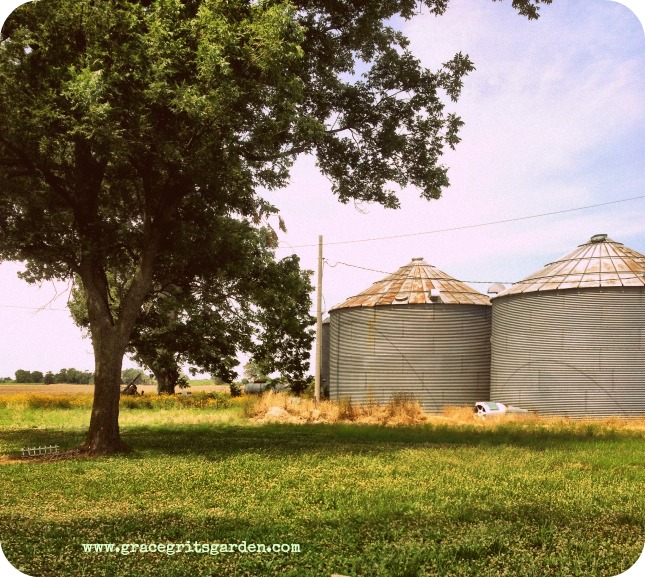
the someplace, Mississippi Co, Ar. Tate Farms

The setting for my story is part of me. The place I grew up during the time I grew up. 1972. And even though I lived that time and place, research is a big part of my project. Making sure I have the description, sound, smell, feel of a specific place or object accurate for 1972, that’s imperative. I want my readers to see through my eyes. Feel what I feel. Taste the Jiffy Pop.

Mark Twain said Don’t say the old lady screamed. Bring her on and let her scream. That’s what I’m trying to do. Letting the old lady to scream takes work and time and research and remembering.

A sample of the things I’ve researched the last few days: Watergate, Chinese finger trap, phases of the moon in 1972, Memphis cotton trade, Mark Spitz. Just your regular, run-of-the-mill, 1970s stuff.

Sometimes I listen to seventies music while I write. Sonny & Cher. Tony Orlando and Dawn. Marvin Gaye. Yes I do. That takes me back to my groovy cassette player as quickly as anything. (I loved that thing. I hated that thing. It ate more tape than it ever played.)

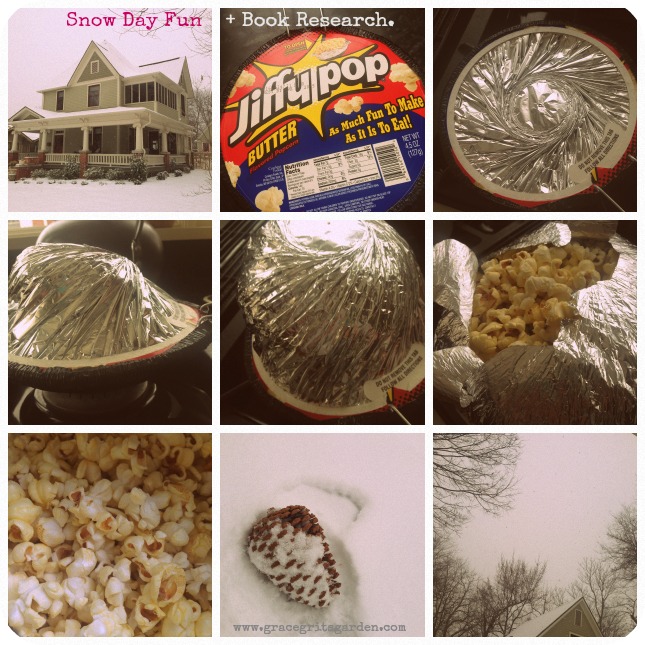
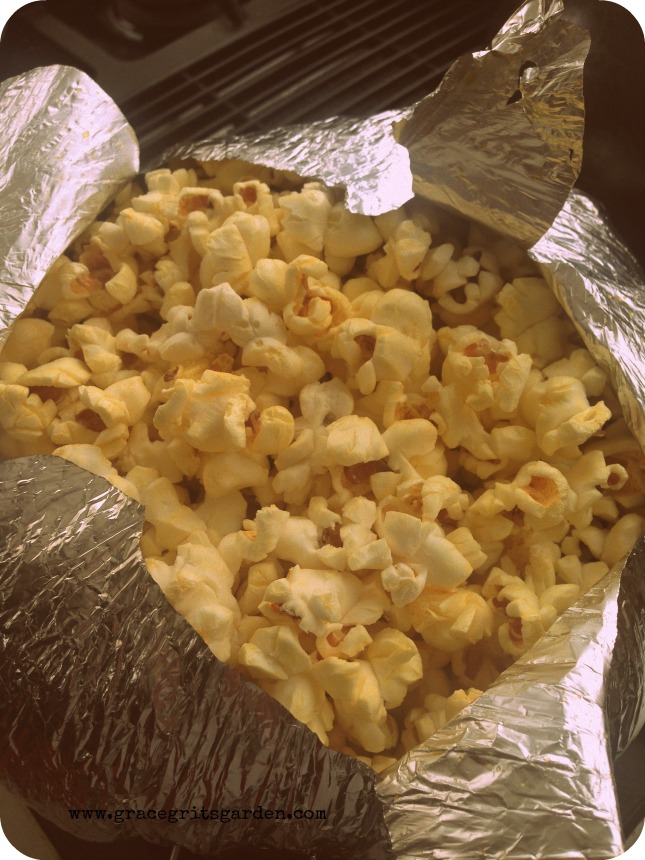
Saturday I even made Jiffy Pop. Jiffy Pop was a weekend tradition at our house. Shaking that pan over the flame, hearing the kernels sizzle, then seeing the foil expand like a balloon (more quickly than I remembered) made that memory as real as it could be forty years later, plus it was a fun snow day activity.

on researching and writing and keeping it real

On researching and writing. Jiffy Pop to keep it real. www.gracegritsgarden.com

Now, back to writing. If anyone needs me, knock three times on the ceiling, but only if you’re bleeding (to quote my friend Laurie Reichart).

Happy Monday.

Grace Grits and Gardening

Farm. Food. Garden. Life.

[tweetthis]Writing, research and eating #JiffyPop to keep it real. #writingabook #fiction #1970s[/tweetthis]

Knock Three Times, Tony Orlando with Jimmy Fallon & Will Forte (sorry Dawn)

“The challenge of the writer is to transform—artistically and imaginatively—a unique personal experience into a universal, meaningful story.”

― Hillel F. Damron

the Economics of Cursive Handwriting

February 19, 2015 By Talya Tate Boerner

Since I’ve been on a letter writing kick in 2015, I’ve been thinking more about cursive handwriting and how something that was once a mainstay elementary school lesson is becoming extinct. Although my cursive handwriting has morphed into a hybrid combination of cursive and print, handwriting and old-fashioned letter writing go hand in hand.

Do you remember the cursive alphabet cards and how they lined the wall of the classroom like a wallpaper border above the chalkboard?

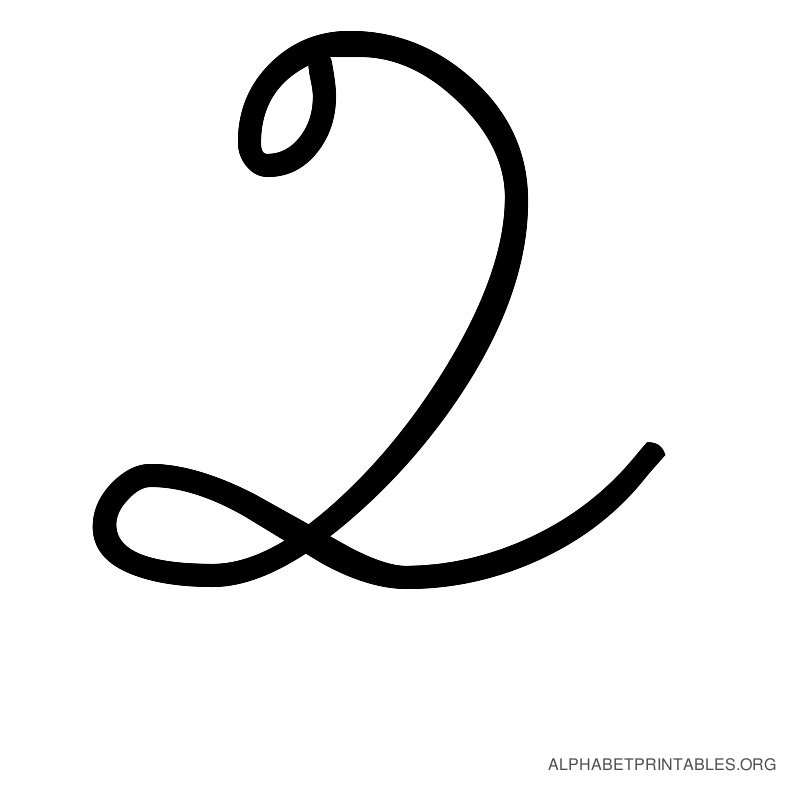
Big Q, little q.

That cursive Q was the strangest letter of all, and I’m certain I never perfected it. But somehow I think trying to form those calligraphy-like letters was an important lesson, a ritual that taught fine motor skills and discipline and patience.

cursive letter Q

When I was a kid, this was a cursive Q. Someone (Thomas Jefferson?) obviously confused it with the number 2.


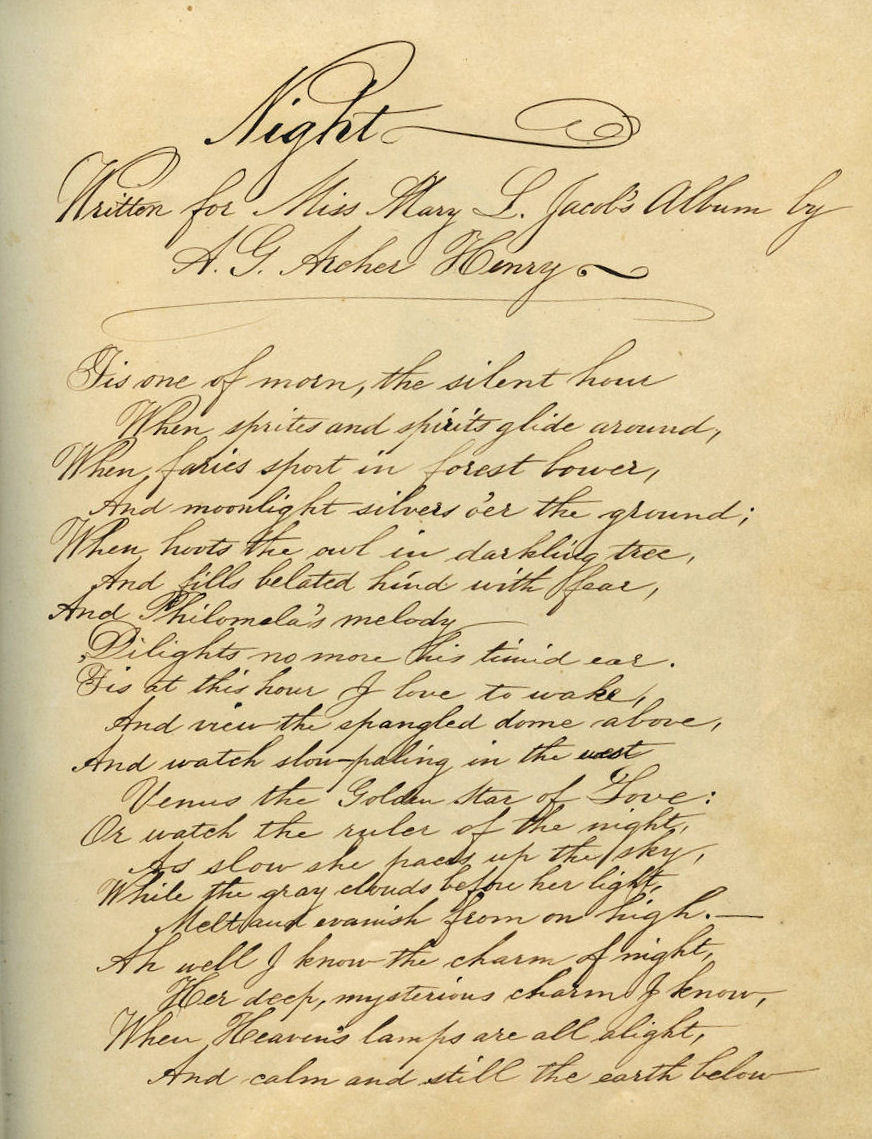
There was a time when cursive handwriting was considered artwork. Look at this beautifully handwritten poem from a pre-civil war autograph book (courtesy of The Graphics Fairy).

Beautiful handwriting


I am not an educator, but I’m a parent. A parent of children who learned cursive in the 1990s, and I’m glad they did.

I understand that life has evolved and kids have changed and there is so much to learn and so little time in the classroom. I understand. I’d also like to think there is value to learning cursive writing beyond cursive writing. Perhaps sitting in the classroom practicing that Q over and over is what helps me sit at my desk today and write even when the words aren’t flowing the way I need them to flow. Maybe something as simple as cursive handwriting is the backbone for what follows. Reading. Fine Motor Skills. Hand Eye Coordination. Writing. Critical Thinking.

But.

Don’t we have more important things to do?

We have technology now, which is life-changing and if I had to live one day without my MacBook Air and iPhone, I’d go into sweaty withdrawals. Technology includes fabulous benefits and makes sitting at my desk and typing those cursive words easy. Kids are sharp. They know things. They tell us which apps to download and fix what needs fixing.

But.

Everything comes with a price. I was an economics major and this is basic stuff. Sacrifice one thing to choose another. Trade-offs create opportunity cost. If I choose to waste two hours on Facebook, I’ve sacrificed the opportunity to write a thousand words. And if instead of spending time on Facebook, I had written a thousand words and sold the story for $200, the opportunity cost of wasting time of Facebook is greater than mere time.

In our schools, if we trade-off cursive for more time to learn programming, what are we losing? And vice versa.

I believe we grow up to be the sum of our experiences. And there were plenty of experiences, not only cursive, that I found useless or a waste of my valuable young time. Math word problems, making my bed, going to church, practicing the piano, mowing the grass. If those things had never been part of my life, I would have had tons of time to do something else. What would the opportunity cost have been? Would I be the same person I am today? Something to think about.

Bottom line. Everything we trade-off somehow affects us. Maybe it’s worth it. Maybe not.

What do you think?

Grace Grits and Gardening

Farm. Food. Garden. Life.

[tweetthis url=”http://bit.ly/19BRIY8″]Is there value to cursive writing beyond cursive writing? #opportunitycost[/tweetthis]


« Previous Page
Next Page »


Hi! I'm Talya Tate Boerner. Writer, Reader, Arkansas Master Naturalist / Master Gardener, Author of

THE ACCIDENTAL SALVATION OF GRACIE LEE (2016)

GENE, EVERYWHERE: a life-changing visit from my father-in-law (2020)

BERNICE RUNS AWAY (2022)

THE THIRD ACT OF THEO GRUENE (coming 2025)

Recent Ramblings:

  • Sunday Letter: 11.23.25
  • Maggie and Miss Ladybug: My New Children’s Nature Book
  • Sunday Letter: November 9, 2025
  • Sunday Letter: Oct 26, 2025
  • Sunday Letter: Oct 5, 2025

Novels:

Coloring Books:

Fiction-Themed Coloring Books

Backyard Phenology:

Children’s Nature Book:

Never miss a blog post! Subscribe via email:

Looking for something?

Categories

All the Things!

A to Z April Blog Challenge Autumn BAT Book Reviews childhood Christmas creative writing prompt Dallas Desserts Fall Fayetteville Food Gracie Lee Halloween Hemingway-Pfeiffer holiday recipes home humor Johnson Family Keiser Lake Norfork Lucy and Annabelle Mississippi County Mississippi Delta Monarch butterflies Munger Place Nana nature Northeast Arkansas Northwest Arkansas Osceola poem Reading Schnauzer simple living simple things spring spring gardening Summer Talya Tate Boerner novel Thanksgiving The Accidental Salvation of Gracie Lee Thomas Tate Winter Wordless Wednesday

Food. Farm. Garden. Life.

THANKS FOR READING!

All content and photos Copyright Grace, Grits and Gardening © 2025 · Web Hosting By StrataByte